Carl Jung, Joseph Campbell and others have made archetypes – the stories, myths, themes and symbols that unconsciously influence our lives – a familiar concept. This Heroine’s Journey goes a step further providing a measurement tool to uncover and harness the transformational power of archetypes. Using the Heroine’s Journey ‘What Story Are You Living? questionnaire it will help you:
- Discover the archetypal patterns and themes unconsciously influencing your life.
- Replace unproductive life patterns by awakening unrealized potential
- Discover hidden strengths, motivational triggers, and new career directions, and
- Improve personal and workplace relationships.
This is a The Heroine’s Journey guide for discovering and directing the unconscious influences that drive your life story.
Ticket for this 2.5 hour masterclass in Rome with Peter de Kuster costs Euro 195 excluding VAT per person (minimum of 5 participants)
This maseterclass is offered weekly in the summer. If you have any questions about the program please contact us email at peterdekuster@hotmail.nl
About Peter de Kuster
Peter de Kuster is the founder of The Heroine’s Journey & Hero’s Journey project, a storytelling firm which helps creative professionals to create careers and lives based on whatever story is most integral to their lives and careers (values, traits, skills and experiences). Peter’s approach combines in-depth storytelling and marketing expertise, and for over 20 years clients have found it effective with a wide range of creative business issues.

Peter is writer of the series The Heroine’s Journey and Hero’s Journey books, he has an MBA in Marketing, MBA in Financial Economics and graduated at university in Sociology and Communication Sciences.
Here is an introduction to this seminar:
HOW AND WHY WE LIVE STORIES
We are storytelling creatures. Listen to people talking in a restaurant, at the water cooler or at a party and you will quickly find that the majority of what they say is in the form of stories. We connect by telling each other stories. We can better understand ourselves by recognizing and exploring our life narratives. Your life story is the tale that your repeatedly tell yourself about who you are, what you want, what you can and cannot do. Before the second year of life, we are sensitive to the tone of stories lived around us, and we have already begun collecting thousands of images that resonate emotionally with us in some important way. At first the plots are inconsistent and illogical – much as our dreams continue to be. By elementary school , we follow particular rules about the beginning, middle and ending of stories, so they begin to make sense. By adolescence, we tell ourselves consistent stories about our lives that define who we are, how we came to be that way, and where we are headed. We see events that we can recount as vignettes of our central life narrative.
Although there are as many variations of life stories as there are individuals, people tend to crete narratives according to a finite number of templates. There are a very small number of general narrative forms in the world’s literature, movies, art. The same is true of characters and the roles they play. How can this be?
In the first part of the twentieth century, the psychiatrist Carl Jung recognized the universality of characters and situations. Just as there are certain musical tones that sound resonant across cultures, there are similarly a universal set of roles, situations and themes that are recognizable by everyone. These universal templates are called archetypes, which is derived from the Greek archetypos, meaning ‘molded first as a model’ (Merriam Webster 2002). Jung, and many other after him, saw that these stories which recur in literature and art are the same narratives we as humans live. For example we all recognize the love story whether we encounter it in a movie, an opera , or a novel. And when we fall in love, we experience for ourselves what that story is about. When we are in a loving relationship, we not only learn major life lessons (in this case about intimacy, sensuality, pleasure, and commitment) but we also feel a sense of connection to all the other people who have ever loved deeply. While each love is different, there is a deep pattern that transcends these differences. When we understand the stories and recognize their universality, we can connect with each other at deeper and more conscious levels, using the archetypal stories as the foundation.
This may be especially true of the sacred myths of cultures, which are particularly archetypal, as they express in metaphor people’s actual experiences. These stories do not necessarily have to be taken literally. Rather, the concrete outward actions symbolize inner experiences. We read the story of an outward journey and something resonates in our inward journey.
This is why people talk about ‘life journeys’, even if they have never outwardly left the town where they grew up. People connect immediately to a journey story from another culture finding resonance with the characters and the form and the phases of the journey, even if the particular details are not familiar. Such stories influence people for good or ill. Archetypal stories can provide breakthroughs in insight and move people toward harmony and success, but such stories are equally able to tempt people toward less productive, even destructive behaviors. Either way, an understanding of the archetypal narrative can enhance insight or enable people to break free of destructive patterns.
The archetypal stories described in this seminar are those associated with the heroine’s journey, which is a model for the individuation process (the process of finding yourself and connecting to your depth and your full potential). They are named by the primary character in each story: Dreamer, Independent, Warrior, Caregiver, Explorer, Lover, Outlaw, Creator, Master, Magician, Sage and Jester.
Living the Stories in Everyday Life: Stages and Situations
When we are living a particular story, we tend to see the world from its vantage point. What we notice in the world and what actions we think make sense grow naturally from that story. For example when someone who is living a Warrior story is having a difficult time with another person she may react in a strong and challenging way, defending her own position. If this person were living a Caregiver story, however, she might instead show concern for what was causing the other person to be difficult, seeking to understand and reassure. When we develop narrative intelligence, we are able to see why we react the way we do and understand the different assumptions and behaviors of others.
There are a host of characters and situations from which these stories are drawn. Such characters have come to be known as archetypes, and they define basic stories, although for each person the details will be unique. These archetypes can be looked at as guides that help us know when we are on our best path and taking the most appropriate action. Your results from the Heroine’s Journey questionnaire help you identify these characters as a way to make sense out of the stories you are living, which allows you to create a richer and more satisfying life.
Many people recognize over time that there is one story that provides the central meaning and purpose of their lives. In addition, other stories are lived out at different times and places. If you think about it, you may notice that different stages of life have offered you new situations, new scenery, new people to be with, even the unfolding of a new storyline. You can see such situations as a stage set, with costumes and supporting characters that seem to pull you into a story line (the plot to be lived out). Such settings have immense power.
Certain life stages typically place us in situations that invite us into specific narratives. For example: if you had a very happy childhood, you likely lived the story of the Dreamer (Innocence). Others were caring for you, and you simply had to trust their wisdom, experiment, and learn what to do to succeed. Living this story provided you with a baseline sense of trust and optimism about life. Living this story provided you with a baseline sense of trust and optimism about life. If, on the other hand, your childhood was difficult you may have lived an Orphan story. This does not mean that you were literally orphaned (although it could). Rather it means that the adults in your life were too distracted, unskilled or wounded to care for you properly (physically, emotionally or intellectually). In this case, you may have experienced a story that had as theme the challenge of coping in a situation of minor or major deprivation or wounding. Likely this would provide a baseline approach to life that was more cautious and realistic, even pessimistic. Or you might have lived both stories – either sequentially (if your life situation changed) or the same time (if your experience with the caregivers in your life was mixed).
As you grew older; you may have become less dependent upon your parents and other authority figures, wanting to explore your own identity and the world outside. You might even have become somewhat oppositional, especially in your adolescent years. You might think of this as living an Explorer story; which exemplifies the gifts of independence and identiy. At roughly this same time in life, you may have become interested in romance; and so you began living out a Lovers’ story; developing the gifts of intimacy and sensuality. This may have led to marriage and children in which case you suddenly needed to live the story of the Caregiver, demonstrating the ability to nurture and even sacrifice for others.
The list of stories we may live at different stages of our lives can go on and on. The major point here is that success in life is often determined by how well we live out these stories, for it is in the living thtat we develop in mature, responsible, moral and successful adults.
So many people today talk about the need for character – in public officials, in the heads of corporations, and in the young. However character cannot be formed by simply enjoining people to act appropiately. We all know from making New Year’s resolutions that simply deciding to do or not do something is not enough to guarantee success. Becoming good, moral and successful requires knowledge of how to develop the inner qualities that make it easy to do so. Every life situation carries within it a call to live a story that offers experiences that can make us great – or, conversely, bring out what is petty, small or harmful within us. It is much easier to avoid the slippery slope of life’s negative temptations and traps when we can recognize the positive potential within situations.
The stories identified in this seminar link everyday life twith the great, mythic stories that inform what it means to be human. Many people, however, sleepwalk through stories that emerge naturally in certain life stages and life situations and consequently they lack a sense of meaning and purpose in their lives. At worst, living in this unconscious way decreases their ability to gain the gifts associated from living the great stories; leaves them feeling alone with their problems, and decreases their ability to become the kind of mature and wise people capable of making a positive difference to their families, friends, community and field of work. When people lack the ability to know what story they are living, they may fail to develop the qualities required to take adult responsibility for the state of their families, communities and the larger world.
When we recognize that we are living a unique personal story, as well as one of the universal great narratives , our lives can be filled with meaning, purpose and dignity. At the same time, we feel less lonely because we can see that we share commonality with all the people in all times and places, who have lived through the challenges of that story.
Exploring Archetypal Stories
Archetypes are psychological structures reflected in symbols, images and themes common to all cultures and all times. You see them in recurring images in art, literature, myths and dreams. You may experience archetypes directly as different parts of you. If you say that on one hand you want one thing and on the other you want something else, you can give archetypal names to those parts, as they generally communicate desires and motivations common to humans everywhere. Although the potential characters within us are universal, each of us expresses them differently, endowing them with somewhat different styles, traits and mannerisms. For example, when the Warrior is an archetype, different kinds of Warriors engage in difficult battles.
The Warrior Archetype encompasses the warlord and the samurai but it also might include the dedicated biologist racing to be on the first team to map the human genome, the advocate for social justice or the member of a street gang. Each of these Warriors follows a different code of honor, goals, style of dress etc; nevertheless all of them are Warriors. The expression of an archetype will be influenced by a person’s culture, setting and time in history but it will also be a manifestation of his or her individuality.
As aspects of yourself archetypes can reveal your most important desires and goals. Understanding their expression in your personal myths and stories helps you gain access to unrealized potential, grasp the logic and importance of your life and increase your empathy for the stories that others live.
In this computer-literate society you might think of an archetype as analogous to computer software that helps you to accomplish certain tasks. For example, a word processing program can be used to write a letter report or book; other applications help with accounting and financial planning and reporting. But these programs would be of no help if you confused their functions. Similarly, the Warrior helps people to be more focused, disciplined, and tough; the Lover helps them to be more passionate, intimate and loving; while the Jester helps them lighten up and enjoy their lives. When a particular archetype is awakened you live out its story. In the process you are able to accomplish definable new tasks. However it is also important that the archetype to be relevant to the task you are facing. If you are going on a date, the evening is not likely to end well if you act out a war story. Conversely most people find it wise not to go into war with the Lover’s vulnerability or the Jester’s playfulness.
In the ancient world, many people projected the archetypes outwardly onto images of gods and goddesses. In the twentieth century, Jung explored the manifestation of the psychological symbols of archetypes and their role in healing. The Hero’s Journey What Story are You Living? makes it easier for you to determine and recognize twelve of the archetypes in your daily life. Understanding your story and archetypes can help you better decide the underlying logic of your life, find greater fulfillment and satisfaction, and free yourself from living out limiting patterns and behaviors. Such knowledge can also increase your insight into other people, thus greatly enhancing your relationships. Most important, understanding these deep psychological structures will make your individuation process – the process of finding yourself and fulfilling your potential- conscious, so that you can gain the gifts associated with maturity, success and happiness.
When each archetype is active in a person’s life, it tends to call forth a particular kind of story or plot. After you have answered the Hero’s Journey What Story are You Living? questionnaire, you will want to become familiar with these stories and plots and their archetypal characters. After you have become familiar with the archetypes, you will want to validate and review your results and then develop some practical understanding of how to use this information by doing the exercises in this journey.

Archetypal Stages of the Journey
The archetypes and their stories are engaged more subtly as they emerge at different stages of the journey. The mythic hero’s journey is outlined in the picture beneath, however, it may or may not be the order in which you have lived the stories of these archetypes. The order in which the archetypes are presented is only a typical order in which they may be encountered during the course of development and thus a logical order in the unfolding of a story. In addition, one or more archetypes may be active throughout your life and become critical to your sense of who you are. To begin your understanding of how archetypes influence your life review the summary of archetypes above and check the archetypes that are most germane to your life at this time.
Note that the hero’s journey is a spiral so you may revisit these stages at different times in your life and at different times in your life and at different levels of sophistication. Sometimes a particular archetype that you encountered earlier in your life is called for again in a later phase of your life. Therefore remember that your ‘The Hero’s Journey What Story are You Living?” results are not static. They may change in the future (you might want to retake the questionnaire every six months or so if you are changing and growing rapidly).

When you have learned to live a number of stories consciously, you can have access to their gifts and approaches in a flowing way; allowing you to respond well in various situations. Once you have gained reasonable story flexibility, you may notice a variety of archetypes active during any given task or situation. For example, you may begin an endeavor full of hope and optimism (Dreamer) but then problems emerge. You face them squarely, noticing who or what is being hurt by whom or by what (Realist). Then you take action to help those affected (Caregiver) and to remedy or eliminate the cause of the problem (Warrior). If you take the issue deeper, you then pursue cutting-edge solutions (Explorer), make needed sacrifices (Outlaw) while safe-guarding the people and values you cherish (Lover). You create a new vision (Creator) taking responsibility to implement the plan, using realistic means and timetables (Ruler). To ensure succes, you shift your own attitudes and behaviors to be congruent with the outcome you desire (Magician), objectively monitor and evaluate progress (Sage) and make the process as enjoyable as possible, eventually celebrating your success (Jester). While this example demonstrates problem solving using the energies of all the archetypes, only some of the archetypes may be needed in a given situation, as noted previously you may experience the archetypes in a different order. If a problem is not adequately solved an additional archetype may need to be available to you and others involved in the situation.
As you review and explore your What Story are You Living? you may find it useful to discuss them with a friend or a professional. Coaches, educators and leaders often use these theories to assist people in their personal and professional journeys. You can also use the insight derived from understanding archetypes to increase communication between team members or a project team; or to foster environments that encourage people to fulfill their potential.
The Archetypal Stories and You
The What Story Are You Living? questionnaire offers information to help you begin a dialogue with yourself that can lead to greater insight into the complexity and uniqueness of your journey. However it is not designed to put you in a predetermined box. When you read the descriptors of each archetype you may reach a conclusion about yourself that differs from your What Story Are You Living score. You can read about the archetypes here to validate the results from the questionnaire which is meant as a guide for exploring how archetypes influence your life. The twelve archetypal categories provide a structure that can increase your self-awareness but your journey is your own and unlike any other. A good understanding of your What Story Are You Living? results is an important first step for increasing your self-awareness will help you learn ways to resolve any discrepancy between your choice of archetypes and your score on the What Story Are You Living?.
Discovering the Gifts of Archetypes
The archetypes that are most active in your life are helping you to develop the gifts of that archetype. Some of the most common gifts for each archetype are described in the scheme beneath. The simplest and for many the most important usage of the What Story Are You Living? questionnaire is to help you identify your gifts. One way to discover yours is to notice what are good at and what energizes and motivates you. Your highest What Story Are You Living? scores provide important information about your fundamental way of seeing the world what you are naturally motivated to do and, in this way, your fundamental purpose.
If your score for a particular archetype is low, it describes qualities, behaviors and perspectives that may not be at all like you at this time. When a score falls in the midrange, you may relate to some of the traits but recognize that overall the archetype is not what motivates you right now. Sometimes midrange scores reflect archetypes that were more active in the past.

Understanding Archetypes in Others
As you study the archetypes you may also recognize ways of thinking and acting that you admire or dislike in others. Such information can help you better understand and relate to those people. If you want to utilize the understanding of mythic stories in this way, you will need to read through all the descriptions to identify those most relevant to the other people you wish to better understand. Recognizing the roles that others play in your story (whether those roles are positive or negative) is helpful for learning to understand people in your life, both personally and professionally
As you read the descriptions of the archetypes you can use the answers to the following questions to help you identify the other characters in your archetypal plot. First list the people in the following categories, then not which archetype each primarily represents
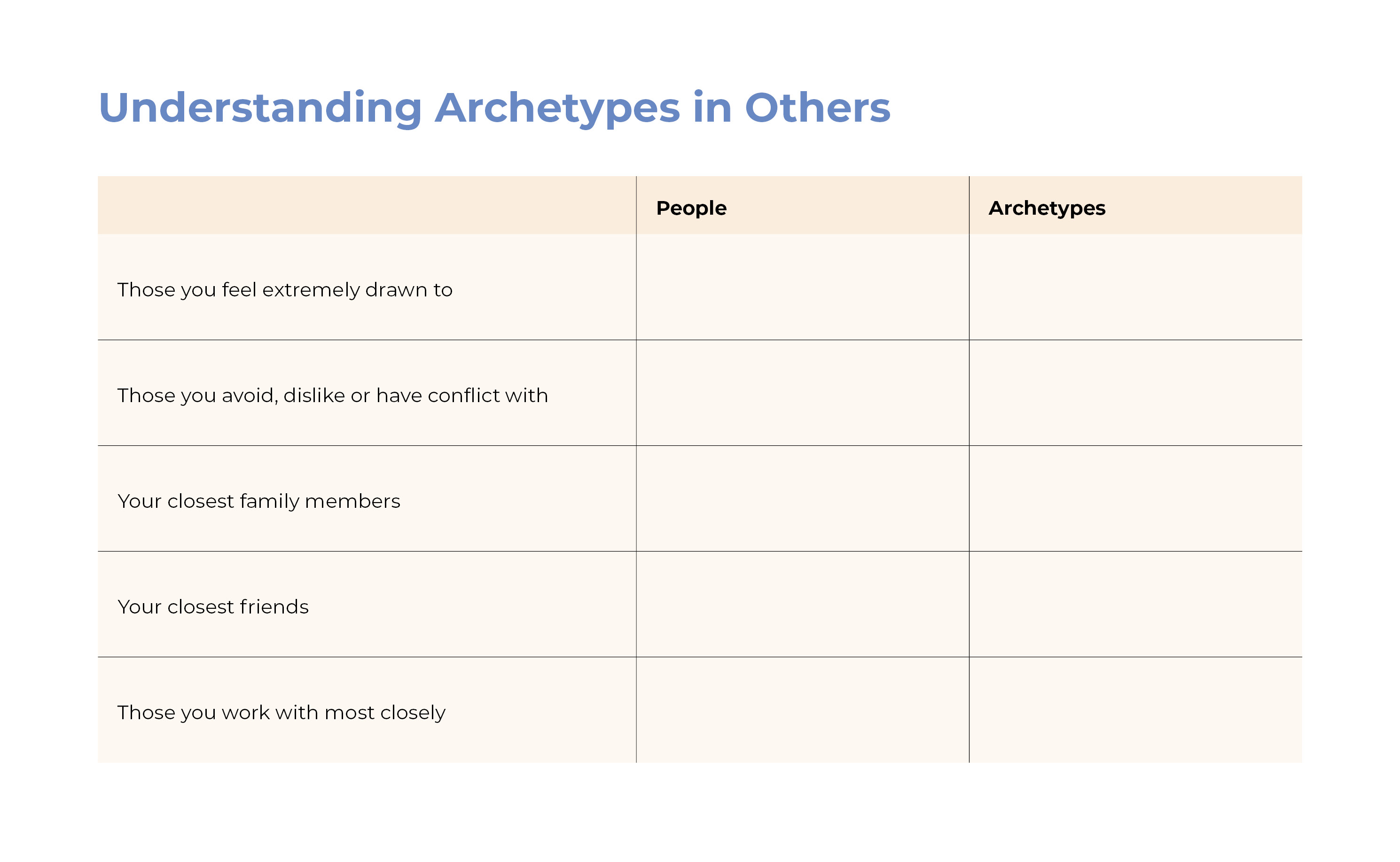
Recognizing the Shadow Side of Archetypes
People who want to understand themselves at a deeper level may find it interesting to explore the shadow side of archetypal development . The shadow includes the negative side of the archetypes, which can limit perception, and repressed archetypes, which can undermine success by causing us to project disowned characteristics onto others. Following are some pointers on how to avoid pitfalls expressed by the shadow sides of archetypes:
- When an archetype is active in your life, it determines the story that you tend to live. In experiencing that narrative pattern, you gain that archetype’s gifts or virtues, and in addition, you learn to face its temptations. The archetypes descriptions summarize some of the major forms each archetypal story can take. If you identify what version of the story you are living – and notice its likely ending – you may be able to predict and avoid negative aspects of that archetype and its story. For example, if you are living a Ruler story, you might have a tendency to be controlling (which can be normal for that archetype). If you can see this danger you can use the strength of the Ruler (the ability to create structures and systems that support people’s authentic gifts) to create group harmony and success rather than slip into the Ruler’s default desire to dictate what others should do.
- The archetypes you are living determine what you notice around you and the actions you take. Your low scores are clues to your blind spots- what you might not notice or think to do. If things are not working for you, you may be living out a story that is inappropriate to the situation that you are in. Finding the story that fits the situation may help you break loose and be successful.
- Negative expressions of an archetype may be an unskilled attempt to express its more positive side. When you see signs of an archetype’s undeveloped and unproductive sides in your own or another’s behaviors you can hold in your mind and heart what the positive version of the story looks like and thereby reinforce it.
- Your undeveloped archetypes especially if they are actively disowned can be projected onto others who you then see as problems, as scapegoats, as rescuing saviors, or even as evil. When you realize you may be projecting, it is best to focus on seeing the good potential within the archetype and then integrate those gifts into your attitudes and behaviors Sometimes it is helpful to notice the part of you that has some of the negative impulses that you find yourself judging so harshly in others.
- Sometimes archetypes can become so habitual in their expressions that you may succumb to a trancelike state. Under such circumstances, regardless of what happens, you will respond from that archetype’s perspective, whether or not it is appropriate or useful to do so. In this case, the archetype is no longer empowering you, instead it has essentially died as an archetype and stayed on as a stereotype, which limits your options. If you notice a story that feels more like an old unfulfilling habit rather than something that gives your life meaning and juice, it is best to try to avoid the behaviors associated with that archetype.
- When archetypes are highly active (high scores) or repressed (low scores) they can pull you into negative patterns, behaviors and ways of thinking. Understanding the common traps or pitfalls or archetypes can keep you from failing prey to their temptations.

Guidelines for Working with Archetypes
As you explore how archetypes influence your life, keep the following key points in mind.
- Each archetype and each individual has special gifts and challenges. There are no better or worse archetypes
- What Story Are You Living? scores are meant as an aid to self-discovery and personal reflection. The determination of which archetypes are active is a personal one. You should not let anyone tell you what archetypes are active in your life, and you should not determine archetypes for others. You can, however, have a hypothesis that improves how you relate with another individual, and you can test that theory in the laboratory of life (i.e. does a particular archetypal theory help you relate better to a person?).
- The purposes for working with archetypes include the following
- – Increasing self-awareness
- – Finding greater fulfillment and meaning in house
- – Improving personal, family, community and workplace relationships
- – Expanding abilities, perspectives, and optionis
- – Escaping habitual archetypal patterns that have become limiting rather than empowering paths
- – Learning to be actively engaged iin charting your life journey
Most people have one of more archetypes that remain stable over time and provide a sense of core meaning and identity. Other archetypes often change and shift over time as you face new life stages and challenges.
The journey is a spiral one, and therefore you may experience archetypes in an order that is unique to your own journey. In addition, each time the archetype becomes active, you may experience it at a higher and more profound level.
The emergence of archetypes in your life is generally an unconscious process. The What Story Are You Living? questionnaire helps you make that process conscious. Once you are aware of the archetypes that are active in your life, focused intent can help an archetype awaken and can influence the level of the archetype’s expression.
Think of archetypes as seeds within the unconscious. These seeds receive the ‘sunlight’ necessary for growth when you seek out people (family members, people in your ethnic group, co-workers, friends) who reinforce the archetypes you want to develop. This nurturing along with your own conscious decisions encourages the archetypes to ‘sprout’.
You can also look at archetypes as sources of energy that exist in the unconscious that help you find the motivation to maximize your gifts and abilities, and to become more developed and mature. This energy can assist you in having a greater quality of life (i.e. being happier and more successful as you fulfill your potential).
If you gained the gifts of an archetype in the past, you can retain the gifts even though the narrative pattern may no longer be dominant. Archetypes are natural to the human psyche, so they stand in waiting, available when they are needed. Pay attention as you read through the descriptors to archetypes that may have been active in your life in the past, even if their current scores are not as high .It is likely that you still have access to the gifts of these archetypes, even though they no longer give you energy or determine the flow of your life.

Steps for Validating and Understanding your Results
The Heroine’s Journey Questionnaire can help you reflect on the archetypal stories most prominent in your current life. By giving you a sense of which archetypes are dominant in your life and which ones are in the background, The Heroine’s Journey Questionnaire assists you in understanding the mix of stories that informs your life narrative.
As explained earlier, active and dominant archetypes may change from time to time depending upon your circumstances. As archetypes are not static, you may wish to retake the questionnaire as you progress on your journey, when you are stressed, or when you undergo major life changes, such as marriage, job change, or geographic relocation. To learn about the archetypes currently active in your life, as well as those that may have been active in the past, you will need to refer to the archetype descriptions. Once you have acquainted yourself with the archetype descriptions, use the following step-by-step process to help you identify the archetypes active in your life, determine archetypes active previously in your life, and intepret your results from the Heroine’s Journey Questionnaire.
Step One: Record how the archetypes function in your life
Refer to the Archetype Score-Ranges worksheet where you wrote the names of your highest, lowest and midrange archetypes. Read the meaning of their functions in your life. Then, using the scores for the archetypes, follow these steps to help validate your results:
- In the 24 to 30 range, circle the one or two archetypes that seem to be the most characteristic of you. (if you have no scores in this category, move down to your top three scores in the next range – more if you have a tie – and circle the one or two that seem most like you).
- In the 18 to 23 range, put a star by any archetype that seems enticing to you and that you might want to have more in your life. Put a check mark by any that may have been more active earlier in your life than they are now
- In the 6 to 18 range, put an X by any archetype that (1) reminds you of some person you find difficult or bewildering or (2) that reminds you of a situation that has been difficult for you to manage or resolve. Put a star by archetypes that you wish you had more of in your life.
Step Two: Validate your scores
The Heroine’s Journey Questionnaire is not a substitute for your own judgment. Rather, it is a mirror to help you have a conversation with yourself and others about the stories that influence your life and that create or inhibit the satisfaction you get from life. If, after reading the relevant descriptions any of your scores feel inaccurate, there are several steps you can take to check them against your experience. Remember you get the final say about what is true for you.
- Put marks by archetype scores you wish to reconsider and make brief notes why
- Check your responses to the questions on the Heroine’s Journey Questionnaire for that archetype. Go back to your Heroine’s Journey Questionnaire and read the questions and your responses to any archetype on which you scored differently than you expected. Try to determine if you may have read a question somewhat differently than others might. Then look back at the archetypal description to see if the archetype is dominant in your life but with a somewhat different style or expression than the questions reflect. Plese not the the Rule Breaker scale does not measre the outlaw or revolutionary aspects of the Rule Breaker archetype. The Rule Breaker questions on the Heroine’s journey Questionnaire focus more narrowly on the experiences of loss and letting go. You may score low on this archetype if you express it as the outlaw or revolutionary.
- Notice whether you have a mixture of high and low scores for the archetype in question. You may be expressing the archetype in a particular style or modality but not in others. If you think the archetype is more active than the questionnaire would suggest, then notice the items on which you scored low. These may describe aspects of the archetype that are not currently expressed in your life, even though the archetype, over all, is strong for you.
- Determine if the level of the archetype in your life is higher than that tested by the Heroine’s Journey Questionnaire. The questions are most often framed at the midrange level for an archetype, tapping a mix of positive and negative aspects Sometimes a person in whom an archetype is expressed at its highest level may score low in that category. For example, if you are a wonderfully generous, compassionate, and giving person and you also have ease in setting boundaries, saying ‘no’ and taking are of yourself as well, you may be an exemplary Caregiver. However since most midrange Caregivers are less good at caring for themselves than for others – and the questions on the Heroine’s Journey Questionnaire reflect this imbalance – your Caregiver score may not reflect the full strength of that archetype in your life.
- Be alert to other influences. Look back at the items for the archetype or archetypes that you question and determine if your answers genuinely reflect what you really think and feel, or if they reflect what others (partner, parents, teacher, employer) think you should be.
Step Three
Understand your high scores
- Determine the four archetypes that are highest for you. Write the names of these archetypes in the spaces provided, starting with the archetype with the highest score and working down.
Highest archetype
Second highest archetype
Third highest archetype
Fourth highest archetype
These are the archetypal characters likely to be most influential in your life right now. Your leadership approaches are likely to reflect the stories of these archetypes,with their corresponding needs, aspirations, and pitfalls.
The archetypes you are living are helping you to develop their gifts. If an archetype has been active in your life for a long time, it is possible that you already have these qualities.
2. Review the descriptions for the strengths and pitfalls of your highest archetypes. Refer to thedescription of your highest archetype, specifically noting the characteristics. In what way is that energy expressed in your life right now? It surprises people sometimes to find that they exhibit both the positive and negative qualities of an archetype. Your Heroine’s Journey Questionnaire results will not tell you whether you have the strenghts as well as the pitfalls of the archetype. The scores tell you how strongly the archetype affects your life, not whether it does so in a positive or negative way or at what level it is expressed. List the strenghts and pitfalls of your highest archetypes that are most applicable in your current life.
Remember that negative archetypal qualities can be redirected into more positive expressions. You do this by paying attention to what you are thinking and doing and consciously choosing not to act out the negative possibility, experimenting instead with more positive expressions of that energy.
Make notes here about shifts from negative expressions to positive ones that you would like to make:
3. Assess whether the expression of the archetype feels empowering or limiting. Most of the time the archetypes active in your life feel empowering because they give you energy and encourage skills and activities that are right for you at this time. Such archetypal expressions offer resources that can help you develop new skills and excel in ways you never thought possible. However there a few ways that your archetypes can trip you up:
- Your archetypal gifts may make you think that you are better than others. This is called inflation. A clue to inflation is to observe if you feel empty, depleted, or even deflated when that particular archetype expression is over. For example, a person giving a well received talk may feel extremely wise (Sage archetype) like a guru or oracle. However later in his hotel room, he may suddenly feel vulnerable and needy. An archetype can also take you over, so you either live out its story compulsively (for example a person expressing Caregiver who can never say ńo’ or someone expressing Rule Maker who cannot be comfortable when not in control. This is called archetypal possession or archetypal trance.
- Archetypes also can become sterotypes. If you cling to a particular archetypal expression so much that you and others expect that expression, you may become too rigid in that role. Inside you, new archetypes are ready to emerge, but the combination of habit and pressure from other’s expectations can lock you into an old way of being. You can tell that this has happened if you are doing things that once made you happy, but you observe that you are becoming bored and unhappy. The answer is to allow the expression of emerging archetypes to help rekindle your joy in life.
Make notes of ways your active archetypes are empowering or limiting in the roles you play.
Empowering………………
Limiting…………………….
4. Understand the energies of your highest archetypes and whether they are expressed in integrated or conflicted ways.
Integrated combinations If you scored equally (or almost equally) high on two or more archetypes, they may inform your life story in a way that is combined and integrated. Take a moment to make notes about ways your highest archetypes work well together.
Conflicted combinations. Sometimes when a person scores highest on two or more archetypes, the archetypal characters may be in conflict in his or her story. Describe a situation in your life where you say you want to do something but do not do it.
How might you experiment with living out this story at least in small ways?
Think of the parts of you that want to succeed in accomplishing your goal and those that resist. Give them archetypal names. What archetypes are involved and what role does each play in your life?
If any of these roles are in conflict, how might they be reconciled?
Step Four Find Your Dominant Life Story
We are going to look at the setting, tone, characters and plot structure that are present in the events in your life. First, we will look at the archetypal life myth or story that was present in your growing up years. Often this original life story informs your current life, just with more complexity or in a more mature fashion.
Then we will explore the archetypal story that informs your current life using a process similar to the one we just used in exploring your childhood myth. You will be able to see how the two are related in forming your overall life story.
Your Personal Childhood Myth
Setting: Describe the major life setting in which you spent the majority of your childhood time (for many it is likely to be your home, your school or the home of a relative or friend). Consider this the setting of your story. Write the name of that setting here:
Characters: The earliest ideas of the characters in your life story come from the people around you, usually family. List the important people with whom you lived in your early growing up years, such as parents, step parents, brothers, sisters and step siblings. If there was someone else who lived with you or with whom you lived, include them as well (e.g. grandparents with whom you spent summers or an uncle who lived with your family). Be sure to include yourself. Write next to their names which of the twelve archetypes each character seems most influenced by, and the gift that archetype brings. Next, write any of the archetypal pitfalls those characters seem to express.
Tone: In one to three words how would you describe the emotional state, the atmosphere or tone of your childhood family (for example empowering, tense, distant or easy going) Write the tone here:
Plot: To understand the overall plot of your childhood story, it is easiest to combine the plots of several childhood events or stories. In the space provided werite separate brief vignettes describing three memorable stories about yourself from childhood.
The first story should be your earliest memory. Don’t labor over which episode is earliest, just choose one that comes to mind.
The second story should be the family story about your birth, or, if you do not know the story of your birth, choose a family story about your infancy or early childhood
The third story should be your favorite childhood story from a fairy tale, a children’s book, a movie, or a TV program.
The vignettes should be specific, containing a sequence of events, actions or conservations that involved people important to you in the setting you have chosen. If you do not like to write, just make an outline or enough notes for you to decode the plot or the story you are telling
- Vignette of your earliest memory.:
What feelings if any are contained in the story or evoked by the story?
2. Vignette of your birth or infancy story:
What feelings, if any, are contained in the story or evoked by the story?
3. Vignette of your favorite childhood story:
What feelings, if any, are contained, in the story or evoked by the story?
Plot Summaries: A plot is a sequence of events often marked by a series of actions-one character says or does something, another responds, and so on. The plot usually builds to a climax and then moves to a turning point (called a denouement) which ends the suspense. For many people, the same plots recur, and shorter or smaller events may have similar patterns to the main story. In the following chart, summarize the childhood vignettes you wrote about. then write a headline for the story in the same manner that an editor would write a headline for a newspaper story.
Story One
Earliest Memory:
Title (headline):
Archetype: (Which archetype’s plot is the story most like?)
Story Two
Earliest Memory:
Title (headline):
Archetype: (Which archetype’s plot is the story most like?)
Story Three
Earliest Memory:
Title (headline):
Archetype: (Which archetype’s plot is the story most like?)
Review the titles and summaries of the three childhood stories. What is the major combined theme of the vignettes? Theme:
Your Current Personal Story
Setting: While the childhood setting was a family, your predominant current setting may be work, school, home or friendship. Describe the major life setting in which you spend the majority of your time. Consider this the setting of your story. Write the name of that setting here:
Tone: In one to three words how would you describe the emotional climate, the atmosphere or tone of that setting (for example, empowering, tense, distant, or easy going?) Write the tone here.
Characters: List the important people in this setting. Be sure to include yourself (again, you may have only one or two people/characters in your plot, or you may have many). Try to keep the list to the important people who have the most influence on your story. On the line beside each, write which of the twelve archetypes each character seems most influenced by and the gift that archetypes brings. Next, write any of the archetypal pitfalls those characters seem to express.
Plot: To understand the overall plot of your current life story, it is easiest to combine the plots of several events or stories just as we did for your childhood myth. This time we will use only two stories. In the space provided, write separate brief vignettes describing two memorable stories about yourself in the setting that you selected. The first should be about a satisfying time, a time when you felt you were at your best. The second should be about a troubling time when you did not feel at your best. Don’t labor over which events to record; just choose two that come to mind.
Vignette of a satisfying, fulfulling or effective time
Vignette of a troubling time
Plot summaries: As noted previously a plot is a sequence of events often marked by a series of actions – one character says or does something another responds, and so on. The plot usually builds to a climax and then moves to a turning point, which ends the suspense. For many people, the same plots recur and shorter or smaller events may have similar patterns for the same story. Summarize briefly in the following chart the vignettes you wrote about occurring in your dominant setting. And then write a headline for the story in the same manner that an editor would write a headline for a newspaper story.
Story One
Fulfilling time…
Title (headline)
Archetype (Which archetype’s plot is the story most like?)
Story Two
Fulfilling time…
Title (headline)
Archetype (Which archetype’s plot is the story most like?)
Story Three
Fulfilling time…
Title (headline)
Archetype (Which archetype’s plot is the story most like?)
Review the headlines, archetypes and summaries of the two current myth vignettes. What is the major combined theme of the vignettes? Theme
How does this compare with the theme of your childhood myths? How might the plots and themes combine?
Review your titles, plots and feelings for the combined theme. Then, in the following space, write the major combined plot.
Do most of these scenario’s clutter around one archetypal narrative? If so, briefly summarize that archetypal story. If there are several different archetypal stories, what are they?
If you have identified one primary archetypal story this may be your life muth, in which case you may find that your life is enhanced by committing more fully to that story and its possibilities. If you have identified several, live each consciously until it becomes obvious which seems most authentic and fulfilling to you.
Alternative endings. There are many versions of each story and so the endings of similar plots may vary. Consider what you might change in your childhood myth and/or in your current story to be more successful and fulfilled. Use the following space to retell the stories the way you wish they would happen – in the present tense, as if that is how it is.
Story One
Story Two
Step Five Understand your low scores
You may be primarily interested in understanding your high scores and learning from the dominant archetypes affect your life. However, you may choose to examine areas of your life that are affected by archetypes that are not available to you. Sometimes having access to different stories may help you overcome difficulties, adress conflict, and / or move forward in your life. The following analyses can help you understand the archetypes for which you scored low.
- list the archetypes on which you scored lowest and then read about them
There are several ways to understand low scores, and it is important to think through which may be most applicable. The low scores on your graph may represent characteristic ways of organizing the world that do not currently apply to you, or ones which you have not yet encountered in yourself. It is possible you may have difficulty working with people who are living your low scoring archetypal stories. You may also have difficulty in situations that require the gifts and perspectives of these lower scoring archetypes.
2. Establish if any of your own scores are dormant, shadow or allergy. There may be many reasons why you scored low on certain archetypes. Following are three explanations for why your scores might be low and hints about how to determine which one applies to your situation. You will want to know if the archetypes on which you scored low have never been needed, are disowned parts of the self, or are parts that have previously taken you over (in general that determination is made by the amount of emotional energy invested)
- Your low-scored archetypes may indicate that you have not needed these particular archetypes because you have not yet faced their challenges. You can think of these unencountered archetypes as dormant. An enencountered or dormant archetype generates little energy. You may find the descriptions somewhat foreign, and your reaction is likely to be unemotional and disinterested.
- The low-scored archetypes may reflect those characteristics that you actively disown in yourself. If this is the case, these archetypes may represent your alter ego or shadow self, of which others may be more aware than you are. Reclaiming these disowned parts of yourself may provide you with more choices for responding to situations and may make it less likely that you will be unaware of your own actions or feelings. This reclamation is a step toward further personal growth.
- If the archetype is a shadow aspect, you are likely to be more energetic, even ademant that this not an influence in your life. You may think of people influential in your life who do exhibit aspects of this archetype, and you are likely to have a negative reaction to it. Because it is disowned, the archetype is more likely to be expressed in its less differentiated and more problematic aspects. If you have friends who can be forthright with you, ask them, ‘In what ways do I show the positive and negative aspects of the archetype?
- The archetypes on which you scored low may represent qualities that you have overused in the past and need to stay away form. We call this an ‘allergy’. Overexposure to an archetype may make its expression toxic.
- It may be quite obvious to you if an archetype is an allergy. You will know it well but feel an aversion that is something like, ‘Oh, not again’. You also may feel annoyed at people you know who overexpress that archetype. And you may realize that your source of annoyance is your own frustration at over-expression of the very same archetype.
In the following paces make some note about how you might express the low scoring archetypes in your life:
Dormant Archetype(s):
Shadow Archetype(s)
Allergy Archetype(s)
3. Assess situations or relationships that are difficult for you in light of low scores. Recognizing your low scores is important when you are in a situation that seems as if it is defeating you. Often, if you do not know what to do to make it better, you either ignore it or obsess about it. You may encounter such situations because you do not have access to the gifts of the archetype that could help you know how to handle this difficulty.
List two situations that are currently troubling to you:
Review The Archetypal Gifts and use the chart to record the gifts of your low archetypes. Note the ways you may be able to use those gifts.
You can increase an archetype’s availability to you by using the following techniques:
- Recognize its value and decide that the archetype would be a good one for you to express
- Read books, watch movies, listen to music, and view art that reflect the archetype
- Be around people who express the archetype in its positive forms
- Consciously act, dress, speak and think as the archetype does
- Consider when in your life you decided that particular story would not be appropriate for you. Be open to making a new decision about that archetype. (Ask yourself who dissuaded you from living that story or expressing the attributes of that archetype. Also review who in your life might have lived that story so badly that you decided not to be like them)
4. Recognize any tendency to project your shadow archetype(s) onto others. Your low scores can cause you to be more intolerant of others, especially those who express the common pitfalls of the archetypes you most want to avoid. You may find it helpful to actually write the names of people you find particularly annoying or troubling. You can also include people you do not personally know, such as celebrities, politicians, newsmakers and even characters from books, movies or TV shows. Note what is so annoyinig about them and check these against the common pitfalls for that archetype. What archetypes do they represent? Is there a relationship to your low scores?
What is the cost to you of not relating well to people with these qualities?
You may find that you are more understanding of difficult people when you recognize which archetypes are being expressed (although it may be the negative aspects) and you may begin to notice occasions on which those archetypes are espressed positively.
5. Examine your life stages and situations. There are particular life stages and situations that are difficult if certain archetypes are not yet available for you. For example, it is difficult to be a new parent without some access to an inner Caregiver or to be a soldier going to war without some access to the inner Warrior. On the following chart circle any archetype on which you scored low, but that you need because of the life stage or situation in which your currently find yourself.
Step Six Expand your options
People are often liited in their outlook because they think, feel and act in habitual patterns that arise from the archetypes. In order to practice moving beyond the selective focus of your dominant archetypes, pick one issue in your life that feels challenging to you: something that you do not know how to handle or that you feel that you are not handling well or that is not going well. You may expand your options in either an extraverted or an introverted manner depending upon which seems to fit best for you.
- Describe the problem in one of the two following ways:
- Extraverted Option: Explain the problem to another person, then summarize the essence here.
- Introverted Option: Describe the problem in the space provided here
Summarize the essence of the problem:
Continue with the following steps regardless of which option you chose:
2. Describe briefly how you have grappled with the problem or how you might ordinarily react
3. Identify the archetypes reflected in your response:
Archetype:
Archetype:
Archetype:
If you chose the extraverted option, role-play with one other person who plays in turn the part of each of the three archetypes you listed. If you chose the introverted option, write a dialogue with the archetypes you have listed
4. Summarize the advice that can be garnered from how these archetypes act ini the situation you set up. You can do this through additional role-play or written dialogue. Remember that you and others have all the archetypes within you, so you can access their wisdom. However it is easer to do so if you lighten up and do this in the spirit of play.
5. Given these new perspectives, what might you do differently?
You may wish to repeat this exercise on additional paper, using a different issue or challenge. You can also use this exercise to examine past issues in order to think through what might have been, to explore present issues to expand your horizons, or to consider your actions for future issues.
STEP SEVEN Sum up your The Heroine’s Journey Questionnaire results and self – analysis
It is useful after undertaking the detailed analysis included in this seminar to sum up your results. Doing so helps you retain what you have learned about yourself as well as what you have decided to do with that knowledge.
Summary Chart of The Heroine’s Journey Questionnaire results
Insights………………
Desired changes……………………….
LIVING THE HEROINE’S JOURNEY WITH CONSCIOUSNESS
Archetypal stories of heroes and heroines in all cultures help us understand the ideal for how we live. These archetypal stories provide the call to live life to a new level. The results from your The Heroine’s Journey Questionnaire make it possible for you to understand and explore how archetypal stories influence your life. In addition to the analyses you have undertaken thus far, you can use what you have learned about yourself to see where you are on the three major stages of the Heroine’s Journey. The Heroine’s Journey is one way to understand the individuation process – that is the journey to finding your uniqueness and learning to express your highest potential in positive ways in your life, family, community and work. The pattern of living these stories is unique to each individual. The journey described here is in a linear form because it is easier to understand but your personal journey is more likely to be experienced in a spiral way, which will be discussed further at the end of this seminar. The spiral concept is important because we constantly circle back to relive archetypal patterns and each time our experience of the possibilities within any given story deepens.
Each of the twelve stories described in this seminar can be seen as a part of the larger narrative of the heroine’s journey and leading to a heroic gift. All the stories require courage, even though for example the courage of the Warrior (to fight to achieve goals) and the courage of the Lover (to let down barriers to be completely seen and known) differ profoundly. Recognizing which archetypes are active in your life right now is a way of discovering what heroic challenge or challenges you may be facing. Putting your life within this context ennobles what may seem like everyday problems and triumphs and connects your trials, tribulations and exultations to the great heroes of all times. This process can help you to become a more mature, fully realized human being.
The heroine’s journey is the overarching story that prepares us to take our place in the world. This may involve exercising individual responsibility and/or participating in shared responsibilities.
While stories of heroes and heroines in myths, legends and fairy tales ordinarily seem removed from our everyday lives, we can see some of their patterns as we examine our own archetypal stories. Noticing the stages of the heroine’s journey can help us claim the nobility of our own lives, even during life’s most difficult passages.
Each of the archetypes presides over a stage in the heroic journey. Within the larger pattern of the twelve stages of the heroine’s journey, there are three intermediate journeys each of which is aided by four of the archetypal narratives described in this seminar.
The Preparation of the Journey: Dreamer, Realist, Caregiver and Warrior (associated with the ego-level of development)
The Transformational Journey : Explorer, Rule Breaker, Lover, Creator (associated with the soul level of development)
The Return from the Journey: Rule Maker, Magician, Jester (associated with the self level of development)
Each of the stages gives you gifts, and each has its traps – traps that are more difficult to avoid if you are not able to anticipate and recognize them.
THE THREE STAGES OF THE HEROINE’S JOURNEY
The Preparation for the Journey
We prepare for the journey by awakening the four archetypes that provide us with an inner family (Dreamer, Realist, Warrior, Caregiver), thus freeing us from issues determined by our family of origin. The stories associated with the preparation are related to this inner family: the Dreamer and the Realist are two sides of the inner child (spontaneous and wounded) and the Caregiver and the Warrior are two sides of the inner parent (nurturing and protecting).
Living these stories helps uw with good ego development. The open, receptive nature of the Dreamer helps us learn and socialize. The hard knocks experienced by the Ruler help us to be appropiately cautious, realistic, and aware of our own vulnerabilities and those of others Together these stories teach us to be discerning and resilient. Similarly, the compassionate Caregiver helps us to share with others and be nurturing and gentle with them, while the Warrior helps us to be disciplined and tough enough to set and achieve goals and create and protect boundaries. Together these archetypes help us balance getting what we want with showing kindness and consideration to others.
If your highest scores are in the preparation stage. It means you are working on issues related to dealing with the vulnerabilities of being human and also learning to grapple with those difficulties in a way that is socially acceptable in the society in which you live.
You can see the pattern of development of these four archetypes in fairy tales, albeit communicated in metaphorical terms. In the beginning, the heroine has the virtues of the Dreamer because she has the opotimism to begin the journey. Along the way, she has to distinguish between tempters and guides, thus requiring him to balance the Dreamer with the skepticism of the Realist. At some point she meets a dragon or other monster that she must slay (Warrior) proving she has strength and courage, and someone in need she must help (Caregiver). In many stories, the heroine meets an old man or woman who has nothing. The heroine has also little but she shares gladly what she has, demonstrating that she is not just out for herself. She cares about other human beings, showing she has a wise and noble enough heart to take the journey.
When we experience these four archetypes we may demonstrate the qualities that are often identified with the negative aspects of the ego. From a psychological perspective, the ego’s positive function is to keep us safe, differentiate us from others, and give us a sense of individual worth. When we overdo this we may become fearful and lonely and in order to protect our sense of worth (ego) we may make excuses or blame others when we make mistakes.
Then all the life becomes a way to keep the vulnerable inner child safe as the world is imagined as a treacherous place. The Dreamer desperately seeks to please, the Realist uses the victim role to manipulate others., the Warrio preemptively attacks,and the Caregiver obsessively resuces others.
The antidotes to this dilemma which can happen naturally as we experience more and more of life, are to learn how the world works (so you know when you are safe and when not) to gain the emotional intelligence to recognize when you should trust and when you should not and to develop your Warrior strength and your Caregiver ability to care for yourself and others, so that you develop inner parents to provide nurture and coach your inner child. In addition, you are much less likely to experience the ego archetypes if you have taken your soul journey, so that you find an identity deeper than the ego.
The Transformation Journey
Following the preparation, we begin to experience the journey. The four archetypes that help with the journey (Explorer, Lover, Rule Breaker, Creator) preside over a transformation process. The journey can begin with the Explorer’s curiosity about the self and the world or a pervasive sense of boredom, emptiness and dissatisfaction. It also can begin with the experience of loss, when people and things are taken from us or when our ego-defenses are undermined or when we are brought face to face with ways in which we have failed to live up to our ideals (Rule Breaker). Either way, we step out to explore and in the process let go of what is no longer relevant in our lives. In the first instance, we are motivated by hopes for the furture and discover we cannot have a new life without sacrificing some of the old, whereas, in the second, we are moved to seek because much has been taken from us. Either way the initiation of the journey usually entails some suffering or loss.
Although we are ultimately questing for self-knowledge, the conscious motivation of the journey is often to find ourselves and feel at home (or to relcaim that feeling if we have been forced out of what seemed to be a safe haven or personal Eden). In this process, we find who we are through the various expressions of the archetypes active in this stage. We do this in part by what we let go of and in part by what we find that we love (Lover) – people, places – activities – and by what we create in our lives and work (Creator). When we create from the level of the soul – which we do when we are living our purpose – instead of just from the ego – our lives begin to fit and satisfy us.
In mythic stories of the heroine’s journey the heroine embarks on a great adventure (Explorer) experiences difficulty and suffering (Rule Breaker) as well as love of life, of individuals, of causes or places (Lover), which can mitigate the aspects of the Rule Breaker. Ultimately the heroine demonstrates resourcefulness and imagination in finding the way and solutions to obstacles (Creator) and evnetually a treasure emerges (one’s own gifts and nature).
In the dark version of the story, people will wander aimlessly, never finding themselves, develop self-destructive habits or do things that harm others, create endless drama’s in their lives that divert them from their real creativity, and give in to self-indulgent pleasures, rather than committing to real love. The antidote, in all these situations, is to confront one’s own soul and live out one’s own destiny however difficult doing so might be.
The Return from the Journey
The challenge of the return is to share your talents and gifts with the world, once you have found them. Classically: at the close of the heroine’s journey, the heroine comes back to the kingdom and becomes the queen. Thus, the archetypal stories associated with this challenge are those associated with the royal court and the archetypes of the Rule Maker, the Magician, the Sage and the Jester. We find stories about the return generally in legends or histories about extraordinary leaders who,took the risk to serve out of a commitment to the greater good. In our own lives, we can feel royal when we are both true to ourselves and committed to sharing our gifts with the world.
When you know you are are at a deeper soul level, your Rule Maker instills the responsibities to live out your purpose for the greater good of the world, your Magician helps you shift consciounsess to transform or heal, your sage is curious to know the real truth, to share wisdom respectfully with receptive and open minds, and your Jester celebrates the joy of existence in a way that is contagious and helps others enjoy themselves.
If your highest scroe is in the return category, it is likely that you are concerned with issues of how to share your genuine gifts with the world If you run into problems it may be just that this stage is new to you, or that you did not first complete the work of the transformational journey. If you jump to the return without having taken the journey, these archetypes are inevitably expressed in limited or negative forms. The Rule Maker can be self-serving and controlling, the Magician manipulative the Sage opinionated and the Jester irresponsible.
Also, if you enter this stage focused only on your own good, you may become stuk in the dark version of the story. Here, the Rule Maker motivates a compulsive drive for power. The Magician puts a spin on truth to distort public perception. The Sage tries to be smarter than everyone else in order to be more successful than they are. And the Jester escapes all this in pursuing mindless pleasures or conspicious consumption. Understanding the archetypal nature of the heroine’s journey, therefore, is especially critical for various types of leaders or any other group that influences the shape of events and people’s lives.
The antidote for a stuck return story is connecting with a genuine desire to be of service in the world. Each of the four self archetypes brings a gift back to their own world: the Rule Maker brings direction and organization, the Magician brings the importance of perspective, the Sage brings wisdom and the Jester brings the ability to maintain equilibrium. These are the gifts which the Self passes on to the next generation of heroines and heroes.
A Spiral Journey
The three stages of the journey do not ordinarily happen in a neat, linear order. You may find elements of all three in different aspects of your life at the same time, or you may look back over your life and notice a recurring pattern of getting ready, journeying to find yourself, and returning to share what you know and what you have. If you have been at the return stage and find you are again at the preparation or journey stage, it does not necessarily mean you have regressed. It means that you have more work to do on developing an even stronger and healthier ego (preparation) or a deeper, more authentic sense of soul (journey) to go to the next level of claiming your power (self( and freedom (return). Thus we revisit the preparation, journey and return multiple times. With each new journey and return, we learn to express the archetypes in a richer and more mature fasion. This is the spiral nature of encountering the archetypes.
In fact, all three stages might be present in a single event. Let’s say you are making a presentation to a client. At the ego (preparation) level, you are anxious to prove yourself. At the soul (journey) level, you are eager to do the work in a way that is authentic for you and that reflects your gifts. At the self (return) level, you want the outcome of your efforts to serve the greater good of the organization, community, world As you begin to notice which area has the greatest resonance for you, you will begin to realize that is where your consciousness primarily lies. Within each of the three areas, the archetypal stories that score highest for you provide the narrative that most strongly energizes how you face the challenges of each of these three major and larger stages.
Understanding the stories you and others are living is a way of enhancing your cognetive complexity and emotional intelligence so that you can thrive in today’s complex times. I will show you to move from a clear articulation of ‘my story’ and ‘your story’ to find ‘our story’ and thus an outcome that works for both. In a company setting you may notice what story people are collectively living and recognize if it works for everyone, exploring the possibility of finding a new ‘our story’ that brings a greater sense of aliveness and vitality to all involved. Because many people are trapped in stories that no longer fit, the ultimate purpose of the Heroine’s Journey questionnaire is to encourage you to live the stories that will hellp you realize your real potential as a human being.
Analyzing Your Heroic Journey
Review your scores for the stages of the preparation, the journey, and the return and explore the ways the three patterns (which include the interaction of each of the four archetypes) are expressed in your life. A low score in one of the four in each stage may mean a missing chapter in your inner script for living out this heroic theme. For example, if most of your high scores are in the preparation stage, but your Warrior score is low, you may spend most of your time pleasing others. The antidote would be to work on calling up your Warrior so you can become more assertive to protect your boundaries and meet your own goals. Complete the following information to help you analyze the stages of your journey:
Not your positive expressions of the four – archetype combination for each stage
Note your negative expressions of the four archetype combination for each stage
Note if you need to develop a missing or underdeveloped archetype to fulfill the potential of one of the four combined archetype stories
Make notes about any patterns you might like to enhance or change
You may find it hellpful to combine this analysis with the analysis completed in the prior step as a background to writing your life story from an archetypal perspective. You do this by writing a short autobiography that references the universal stories that are active in various life situations and stages as well as noting the overall narrative of your life. You can also draw on the examples of myths and folk tales used in this seminar wrting your own story as if it is a myth, a fairy tale, beginning with phrases like “Long ago and far away, there was a ” or “Once upon a time” Alternative creative ways to express the universal stories you are and have been living are to paint, dance, sing, or act them out (in a one-person show or with others who play the other key characters in your life) If you observe that continuing your current life pattern might lead to outcomes you do not desire, you can also experiment with rewriting your story or otherwise expressing alternative versons of the same archetypal stories (what your story would look like if one or more additional archetypes were introduced or expressed at a higher level? Use the space here to begin making notes for your autobiography.
The Twelve Archetypes
This part of our journey provides comprehensive descriptions of the twelve archetypes. Each archetypal description found there begins with a story from Paris to help explain the context of the archetype. Each archetype also has descriptions of its imagery, its gifts and ways it is seen. This is followed by ways you might experience the archetype when it is active in you, which is typically reflected by high scores for that archetype.
The Dreamer. The archetype which is usually first encountered is th eDreamer, presenting a childlike naivete and trust. The Dreamer exemplifies a basic trust in others, and in the world as a safe place.
The Dreamer is the archetype of the innocent child who depends upon adults for care and safety. When the Dreamer has a setback, she responds by trying harder and by attempting to have more faith and be more worthy. This strategy is based on a deep-seated belief that such efforts will be rewarded in time. The Dreamer is effectively encouraged in children by an environment of love and safety and by protective limits.
Archetypal plot: The Dreamer appears in numerous stories and myths. Think of Amelie. Most often in stories with a Dreamer plot, the Dreamer either takes the role of the trusting sidekick, or the plot concerns the transformation of the Dreamer into other archetypal roles) where the movement is from Dreamer to Realist. In such plots, other characters, Rule Breakers as oppressors, Lovers as tempters, Jesters as con artists – can undermine the Dreamer’s faith.
Other stories that primarily concern the Dreamer:
- By far the most common story of the Dreamer concerns the relationship with a Caregiver (protector) which protects the Dreamer from losing his or her trusting view of life. With the help of a caregiver, the Dreamer can be seen negotiating unanticipated minor conflicts that otherwise be confounding.
- Dreamer becomes a pure, naieve observer for the tragedy and the irony of the world. The reader or viewer is able simultaneously to see events through the eyes of the world and through the contrasting eyes of the Dreamer
- In the tragic form of the story the naivete of the denial of the Dreamer becomes a tragic flaw. If there is a Caregiver in the story, that person is unable to save the Dreamer or others around her from the fatal naivete of the Dreamer.
- Beautiful and sometimes inspiring narratives that show the Dreamer prevailing because of sheer goodness and a commitment to follow the rules and to do things right exemplify another form of the Dreamer’s story. More adult patterns include any number of stories about women protecting their virtue, and both women and men protecting their beliefs by being true to them, whatever the cost.
Imagery: The imagery of the Dreamer archetype can be the beauty of a green meadow, the peacefulness of a small quaint town. In times of difficulty, innocence is associated with hope. Thus in winter, at the darkest time of year, virtually all religions have celebrations that include the lighting of candles signifying the triumph of light over darkness.
Gifts: The Dreamer has incredible optimism and faith that institutions, authorities or gods will provide what she needs. Such faith is very important to the development in children of basic trust in life. There are also adults who just know they will have whatever they need, and often their faith is justified.
Social support: Children need adults to protect them so that they can be dependent and innocent. Even in adulthood, we all need the belief that we will have what we need – jobs, food transportation, health. There is in most every one of us the sense, that our family, government, our employers, and other organizations should take care of us, and that at least most of the people we encounter will be honest and decent. When family, workplace and societal support break down, the Dreamer in any of us tends to wither, leaving bereft of basic optimism and faith in life.
If the Dreamer is active in your life (high score), you have faith that every cloud has a silver lining.
At your best (now or when you fulfill your potential) as an Dreamer, you exemplify what a life of faith and simple goodness brings to the world. You have a basic trust in others and in the world as a safe place, you avoid temptation no matter how strong, and you help the world maintain virtue and fairness. You are now (or potentially) able to model hope, optimism and the awareness that happiness comes from living a simiple, wholesome life. Even when circumstances are difficult, you know how to focus on the positive and not allow the negative to control your sense of yourself or of possibilities for the future. You keep hope alive in the most difficult circumstances either by overcoming problems with positive thinking or by reframing them into opportunities.
You may want to guard against underestimating difficulties or in being overly confident in your own abilities. You may be blindsided by unforeseen problems, taken advantage of by people you know or shaken by being forced to see the dark side of life that you would rather avoid. You can also fall prey to people who promise easy answers that fail to work.
When problems emerge, you are likely to apply traditional and time-honored strategies; downplay the seriousness of difficulties; and/or seek an expert to figure out what to do, all the while keeping the faith that the problem can be solved. You may also do nothing, hoping that rescue will come. Or, if frightened, you may call for help, experiencing real trust that help will arrive.
Others may appreciate the Dreamer’s wholesome and upbeat approach to life. When under the influence of the Dreamer, you may be seen as naive, in need of protection, and not fully capable of puling your own share of the load. This can lead to frustration, or even resentment, on the part of others who have enough problems without having also to take care of you. The Dreamer may be the straight man to other’s jokes, no fully understanding the complexity or irony of the situation. Finally the Dreamer archetype may be taken for granted and not recognized for contributions.
You tend to notice what is good and trustworthy and meritorious in the world and in yourself. You may be oblivious to dangers that threaten, to how hard life is for others around you, to your own limitations, or to unconscious dependency.
You want to be seen as a nice, good and positive person, and you want to avoid doing anything that might seem unkind, bad, or to be a drag on others.
Actions or qualities that you may find beneficial:
- Cultivation of the ability to anticipate difficulties
- Becoming more circumspect before trusting others
- Gaining a realistic appraisal of your own abilities – neither underestimating nor overestimating
- Putting less trust in authorities or in simple easy answers
- Solving as many of your own problems as you can
- Balancing the Dreamer’s virtues with those of the Realist
If one of your lowest scores is Dreamer, you may do one or more of the following (check any that apply):
- Be overly skeptical, cynical or despairing, seeing no hope in whatever circumstances you are facing
- Get annoyed at people who seem wide-eyed and naive or out of touch with reality
- Never have experienced a time or place where you were safe enough to let down, be yourself and trust others
- Have been taught, and believe, that it is not acceptable to be too optimistic or trusting
 The Heroine's Journey